How to Choose the Right Kitchen Remodeler in Tomball, TX: What to Look For Before You Hire
In Tomball, where many homes sit in HOA-governed subdivisions like Northpointe or Amira, a kitchen remodel can involve more than swinging a hammer — it may require permits from Harris County and coordination with an Architectural Review Committee. Knowing how to evaluate a contractor before you sign saves you from costly surprises, stalled timelines, and disputes over who owes what. This checklist gives you the questions and red flags to look for at every stage of the hiring process.
What Should I Ask a Kitchen Remodeler Before Hiring?
Ask about licensing for all subcontractors, proof of insurance, how they handle permits, and whether their estimate is itemized — these four questions reveal more about a contractor than any sales pitch.
Texas does not require a general contractor license at the state level, but trade subcontractors — electricians, plumbers, and HVAC techs — must hold licenses issued by the Texas Department of Licensing and Regulation (TDLR) . Ask any remodeler to provide proof that their subs are licensed, not just their own crew.
Request a Certificate of Insurance (COI) that names the remodeler directly and shows both general liability coverage and workers' compensation. A verbal assurance is not enough — an expired or third-party COI leaves you exposed if a worker is injured on your property.
Also ask who will be your single point of contact throughout the project, how change orders are handled, and how often you will receive updates. A contractor who is slow to respond before you sign a contract tends to be harder to reach once work begins.
How Do I Compare Kitchen Remodel Quotes in Tomball?
Compare quotes by confirming each bid covers identical scope, then look at how each contractor breaks down labor, materials, demo, disposal, permits, and contingency — not just the bottom-line number.
A trustworthy estimate itemizes every major cost category. Watch for lump-sum bids with no line items, 'allowances' that do not reflect real material costs, and exclusions buried in fine print. These gaps often explain why one bid looks cheaper — the scope is simply smaller.
Get at least three written estimates and check that each covers the same work. If one contractor includes permit fees and another does not mention them, you are not comparing equal bids. The lowest number on paper rarely stays lowest once missing items are added back in.
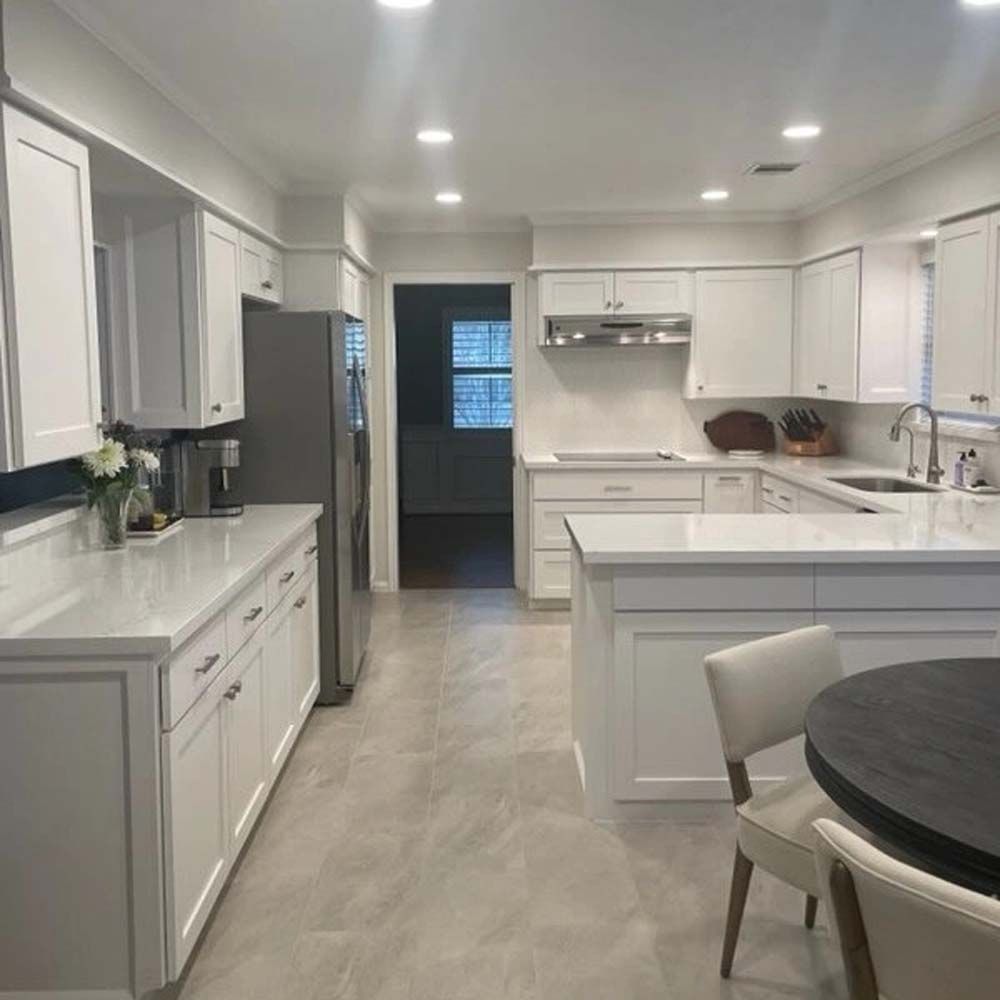
For a real-world example of how scope decisions affect cost, countertop selection is one of the highest-visibility choices in any kitchen upgrade. Custom stone slabs carry longer lead times and higher fabrication costs than in-stock quartz — a quality remodeler walks you through those trade-offs rather than defaulting to the most expensive option. Learn more about kitchen remodeling services in Tomball, TX to understand what a full-scope project typically includes.
Does Kitchen Remodeling Require Permits in Harris County?
Yes — any remodel that moves walls, relocates plumbing, or upgrades electrical panels requires a permit, pulled through the Harris County Engineering Department for unincorporated Tomball or the City of Tomball Building Department for incorporated areas.
Cosmetic-only work — cabinet refacing, a countertop swap, or new light fixtures — may not trigger a permit requirement, but you should confirm with the relevant jurisdiction before assuming. Unpermitted structural or mechanical work can complicate a future home sale and may require costly corrections to pass inspection later.
If your home is in a Tomball subdivision with an HOA, check whether an Architectural Review Committee (ARC) approval is needed. Interior remodels typically do not require ARC sign-off, but rules vary by community. A responsible remodeler advises you on permit and HOA requirements upfront — if a contractor suggests skipping permits to save time or money, treat that as a serious red flag.
Understanding Remodel Timelines and Warranty Coverage
A realistic kitchen remodel runs two to fourteen weeks depending on scope, with material lead times adding two to six weeks before demo even starts — and a written labor warranty should cover installation defects for at least one year.
Typical project phases move in order: design and planning, material ordering, demolition, rough-in work (plumbing and electrical), cabinet and countertop installation, then finishing and punch-list. A cosmetic refresh takes roughly two to four weeks. A mid-range remodel with new cabinets, countertops, and appliances runs four to eight weeks. A full gut renovation with layout changes can take eight to fourteen weeks.
Ask how many projects a contractor runs simultaneously and who supervises your job daily. A crowded schedule is one of the most common causes of a remodel running over its projected end date.
On warranty, distinguish between the labor warranty (the contractor's workmanship) and the manufacturer warranty (the products themselves). A labor warranty should cover installation defects, grout and caulk failures, cabinet alignment issues, and fixture leaks caused by installation error. It typically does not cover normal wear or damage caused by the homeowner. Ask whether the warranty is transferable if you sell the home, and confirm in writing who you call — the remodeler or the manufacturer — for each type of issue. You can see examples of completed interior projects to get a sense of the finish quality and scope a reliable contractor delivers.
When all of these factors align — licensed subs, itemized bids, permit compliance, realistic timelines, and a clear written warranty — you get a remodel that holds up structurally and legally, which directly protects the resale value of your home.
Choosing the right remodeler comes down to verifiable credentials, transparent pricing, and a clearly written agreement that covers what happens if something goes wrong. Those three things, more than any portfolio photo, predict how your project will actually go.
Schedule a consultation with Colter Reid Enterprises, LLC to walk through your kitchen project scope, get an itemized estimate, and review warranty terms before you commit to anything.